
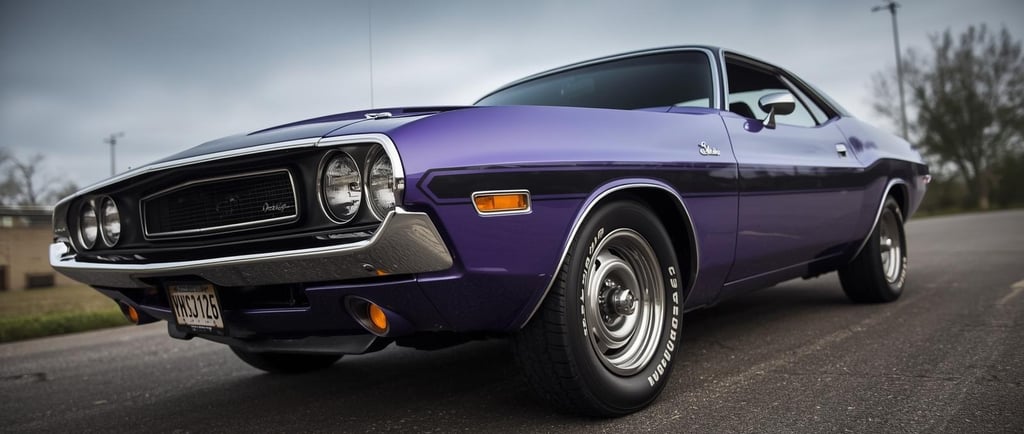
Late to the Party, but Ready to Rule: The Debut of an Icon
In the world of muscle cars, 1970 was a year of absolute giants. While Ford and Chevy had been battling for years, Dodge decided to make an entrance that would silence the room. The 1970 Dodge Challenger arrived with more engine options, more color, and more attitude than anything else on the road.
The Birth of the E-Body
The Challenger was built on the new E-Body platform, shared with its cousin, the Plymouth Barracuda. However, the Challenger was slightly longer and more luxurious. It was designed to be the "gentleman’s muscle car," but don't let the luxury fool you—underneath that long, sweeping hood lived some of the most violent engines ever produced in Detroit.
The Elephant in the Room: Hemi vs. 440 Six Pack
When you talk about a '70 Challenger, you are talking about Mopar Power. Enthusiasts usually fall into two legendary camps:
The 426 Hemi: Nicknamed "The Elephant" because of its massive size and weight. It was a race engine barely tamed for the street, producing a legendary 425 hp (though many say it was much more).
The 440 Six Pack: For many street racers, this was the real king. With three two-barrel Holley carburetors, it provided instant torque that could shred tires in every gear.
A Riot of Color and Style
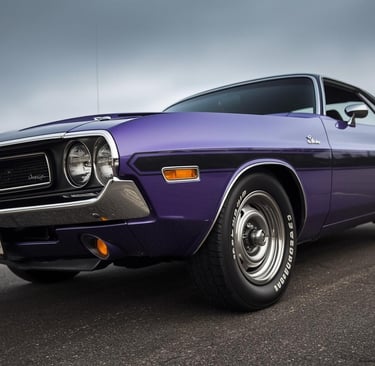
Dodge didn't just want you to hear the Challenger; they wanted you to see it from a mile away. 1970 saw the peak of the "High Impact Colors." Names like Plum Crazy, Sublime Green, Go Mango, and Hemi Orange turned the streets into a psychedelic car show.
Inside, the Challenger featured the iconic Hurst Pistol Grip Shifter. This wasn't just a gear lever; it was a statement. Shaped like a handgun handle, it allowed drivers to slam through gears with military precision, becoming a symbol of the Mopar driving experience.
The Vanishing Point Legend
The Challenger’s status as a cult icon was cemented by the 1971 film Vanishing Point. The image of Kowalski in a white 1970 Challenger R/T, racing across the desert against time and the law, turned the car into a symbol of ultimate freedom and rebellion.
Why it Remains a Holy Grail
Today, a numbers-matching 1970 Challenger is one of the most sought-after prizes in the car world. It represents the absolute peak of the muscle car era—just before the fuel crisis and emissions regulations changed everything. To own a '70 Challenger is to own a piece of American thunder.
© 2023 Reilue. Fueled by Passion
Classic car t-shirts | Muscle car merch
Stay in Gear!
Subscribe to get exclusive offers, early access to new designs, and classic car stories.